
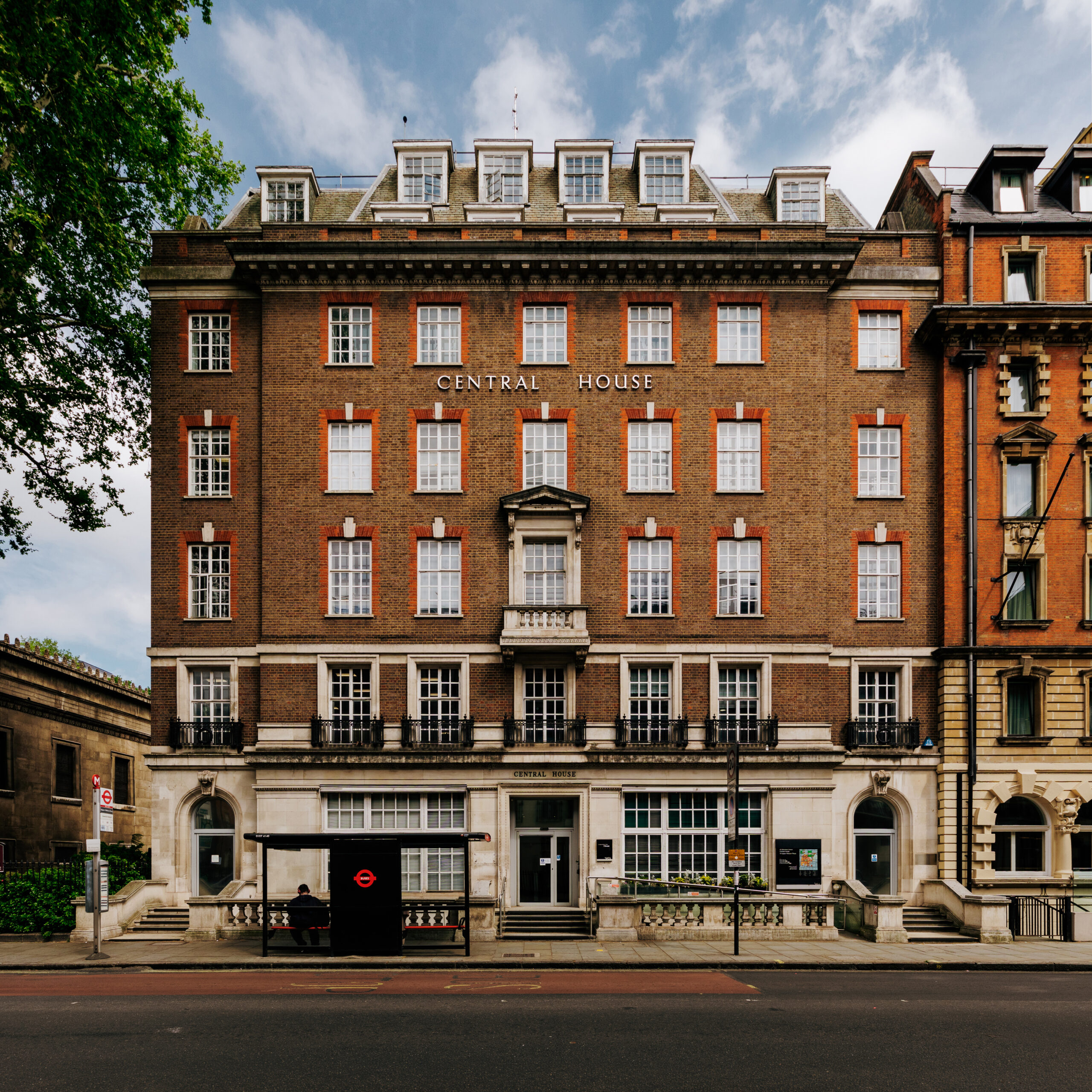
As the Sun Broke Through the Clouds
This is Central House in Bloomsbury, London — home to much of what we do at the UCL Institute for Environmental Design and Engineering. I have had a rather complex relationship with this building ever since I became aware of its existence.
In fact, the first time I came close to it, I didn’t even get to see it.
At the time, I had completed my PhD in Vienna and was going through a difficult period at TU Wien. I was looking for a way out, and had applied for a postdoctoral position based in Central House.
Coincidentally, around the same time, I travelled to London with my boss and a colleague for an international project meeting on the UCL Bloomsbury campus just few blocks away from Central House. My application, of course, had to remain a secret, so while spending the day with them, I kept wondering whether I might somehow get a few minutes on my own — not an easy task with my former boss — just to see Central House for myself.
But I didn’t get the chance.
At that point, I was still waiting to hear back about the application, which eventually led to an online interview and, ultimately, a rejection — although the panel was quite encouraging that I apply for future opportunities if they arose.
The next encounter with the building was more memorable.
I flew from Vienna early in the morning for an afternoon interview for a part-time role — hardly a secure enough job to relocate countries for, but my wife encouraged me to give it a try anyway.
Coming from Vienna, one of the quietest and most orderly capital cities in the world, I arrived in London in the middle of a summer heatwave and emerged from Euston Station straight into noise, congestion, buses, construction, and complete urban chaos.
Central House stood right in the middle of it all.
There was even a bus stop directly in front of the building, for heaven’s sake.
Anyone familiar with Vienna — and especially with the atmosphere around Karlsplatz and TU Wien — may understand why that first intense impression of Central House made me hesitate.
In the end, despite receiving the offer from UCL, I decided instead to accept a full-time position in Liverpool.
So I spent an hour or so wandering around Bloomsbury, went to Waterstones, bought Playing to the Gallery by Grayson Perry for my wife, who is an artist, and headed back home on an evening flight — thinking I had said goodbye to Central House for good.
But then, as luck would have it, while my partner and I were preparing to travel to Liverpool to look for a flat, I received another invitation to interview at Central House — this time for a full-time role.
So once again I travelled to London, this time with my wife — and with a hotel already booked in Liverpool.
For this second face-to-face interview at Central House, our flight was delayed for hours, I somehow managed to get trapped in airport train doors while rushing to make it to the interview, and arrived at the entrance lobby drenched in sweat, having to ask for the restroom first. And yet, against all odds, I somehow nailed the interview and got the offer.
But would I accept it?
This time, both my partner and I had seen Bloomsbury and Central House in their true charm, and the answer suddenly felt obvious.
That’s how we left Vienna for London after seven years.
My relationship with Central House has also changed considerably over the course of my eight years at UCL.
In the beginning, still carrying with me the habits and expectations I had developed in Vienna, I came into the office every day, even though I was squeezed into a desk beside the door in a small room shared with four other academics.
With that mindset of caring about my workplace — and despite the fact that moving to London had practically evaporated the savings in our bank accounts — I would buy batteries for the dead wall clock in our office just to get it running again, and brought in my own water bottle, thermos flask, and small personal items to make the space work better for me.
But after a while, I began to see some of the advantages of London’s ways of living and working.
At the same time, years of working obsessively hard — and having to tolerate many toxic and abusive dynamics in my previous workplace in Vienna — had left me with significant health issues that gradually made me reconsider the idea of regular office-based working.
Then Covid arrived, bringing with it a life-changing personal tragedy, while our office arrangements also shifted to hot-desking — no longer any dedicated desk, or that small sense of permanence and belonging that I am perhaps particularly wired to cherish.
And yet, after that difficult period, and following some well-considered redesign of several working spaces within Central House, I eventually arrived at a new balance in my relationship with the building.
For me, Central House is no longer a place for long solitary hours of daily work, but perhaps that has made it even more precious — now associated with particular occasions, exciting lectures, stimulating conversations and memorable encounters.
To photograph Central House, I returned on three consecutive days during the long weekend we had in May, camera gear in hand.
On the first day, to fit both the building and enough of its surroundings into the frame of my 17mm shift lens, I opened a gate and stepped onto the slab covering the basement of the building opposite to gain a little more distance.
But from that spot, I was one or two metres off the centre line of Central House, and later that evening, when I reviewed the photographs at home, I realised there was simply no way I could accept an image where the vanishing point did not sit exactly at the centre of its entrance.
After all, it is called Central House — not Off-Centre House.
Lesson learned not to argue with the camera position the building demands.
The next day, I returned with a plan to shoot a panorama using the shift lens, only to remember that with my rather basic shifting setup, I could either create the panorama or fully correct the vertical perspective, but not comfortably do both at the same time.
Much of the pleasure of working with a shift lens — seeing the corrected geometry and non-converging verticals directly in the frame — was suddenly gone.
And then there was another problem: even on a weekend, it turned out to be almost impossible to shift the lens multiple times for a three-shot panorama without buses or cars passing through the frame.
Although I eventually managed to capture a rather good image this way, the process was no longer particularly enjoyable, and I was losing control over too many other elements in the scene.
In the end, I had to return to my beloved 14–35mm lens and allow the wider 14mm frame to solve the problem more naturally — albeit at the cost of accepting converging vertical lines on site and only predicting the final corrected composition.
All in all, given my long history with Central House, and its continuing role in my life and career, and with so many casual snapshots of it circulating online, I was keen to photograph it properly — and, most importantly, in the light it deserved.
So, based on what I had learned over the previous two days, on the third day I chose the timing carefully, set everything up, and waited for the clouds to cooperate.
And then, in one of those brief fractions of a second granted by the complicated choreography of passing people, buses, traffic lights, and pedestrian crossings, I got the photograph in the most gorgeous light imaginable — the kind of light that appears when the sun breaks through thick clouds just enough to cast soft yet subtly directional shadows, revealing the building and its surroundings in their quiet clarity.
So I had it exposed on my sensor — Central House, in one of those fleeting moments when daylight suddenly makes you stop and appreciate the built environment around you. My three days of shooting over the weekend were rewarded with a photograph that I still like to stare at from time to time. Central House matters to me, and no matter how difficult my life or my work becomes, I remember many occasions there where I was at my best — teaching, supervising, doing interviews, or just meeting inspiring people.
Comments are closed.